Test-driven development (TDD) and Behavior-driven development (BDD) are the two ways to develop software that puts testing first. They are anchored in the same ideas, which gives them shared notions and perspectives to share. In this post, we will discuss TDD vs BDD with their benefits.
What is Test-Driven Development (TDD)?
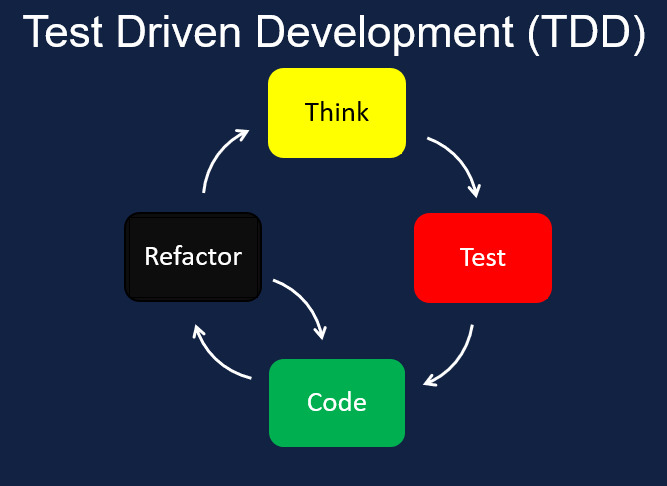
Test-driven development is a technique for developing software that requires building tests that describe the outcomes you wish to see from the changes in the code before any code is created. This step of the process is known as “test-driven requirements gathering.” In the long run, eliminating defects and making the project code easier to maintain are the two primary goals that may be accomplished via test-driven development.
Test-driven development begins with describing the outcome required from the software and the necessary tests to confirm that the software is producing the expected result. Test-driven development frequently goes hand in hand with thought exercises used to design test cases.
In most cases, test-driven development is also significantly dependent on automated testing since the developers constantly run the tests against the code they are producing to measure progress toward completion. Once all of the automated tests have been completed, the developer can verify that they have satisfied the acceptance criteria specified and checked by the tests.
Test-Driven Development Benefits:
Just the necessary code is written.
Following the guidelines, you must refrain from developing production code until all your tests pass. If your project requires another functionality, you’d need a test to drive the feature’s implementation. The code you write is as easy as it gets. As a result, all of the code in the product is necessary to implement the functionalities.
More modular design
TDD focuses on one microfeature at a time. And since you create the test first, the code becomes much easier to verify. A clear interface is included in the code that is straightforward to prove. As a result, your application will have a modular design.
Simpler to maintain
Various program pieces are decoupled from one another and have explicit interfaces. The code becomes simpler to maintain; for example, you may swap out the implementation of a microfeature for considerably superior performance without impacting another module. You’ll even preserve the tests while completely rewriting the application. You’re finished when all of the tests pass.
Code is documented through tests
The test code demonstrates how your code should be utilized. As a result, it provides documentation for your code. The test code is an example code that demonstrates what the function performs and how the interface must be utilized.
What is Behavior-Driven Development (BDD)
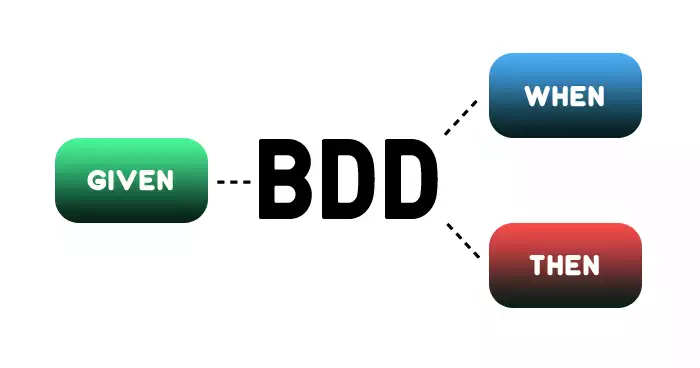
In the same way that test-driven development starts with and is driven by tests, behavior-driven development does the same. Nevertheless, the most significant distinction is that, in behavior-driven development, the tester is responsible for defining the intended behavior of the product. The result is a set of user stories written at a more generalized level of abstraction (don’t worry, we’ll give you an example in a moment).
Gherkin syntax is often used in behavior-driven development to write user stories. The syntax of Gherkin organizes information in plain English such that a computer can subsequently identify it. The text is organized in a manner that explains a collection of inputs and contexts that are present to create an anticipated outcome.
Behavioral-Driven Development Benefits
Strong collaboration.
With BDD, all parties involved have a solid grasp of the project and can all play a role in communication and have positive dialogues. BDD promotes and enhances cooperation. It makes it simple for everyone engaged in the project to participate in the product development cycle. And, by employing simple language, anybody may build behavior scenarios.
Excellent visibility
By utilizing a language everyone understands, everyone has a clear picture of the progress of the project.
The business value dictates the software design.
In reality, Behavioral-Driven Development places a high weight on business value and requirements. Developers may deliver a better outcome by defining priorities with the client based on the value it provides since they have a profound grasp of how the customer thinks. By concentrating on the matter, no ineffective features are created.
The universal language
As previously said, the universal language is understood by all team members, which avoids misunderstandings and makes it simpler for new members to join the working process.
User requirements are met via software development.
Concentrating on the company’s demands, you obtain pleased users, which means a happy business. As the name implies, BDD focuses on behavior, which has a more significant influence than the implementation itself.
More assurance from the developers
Teams who use Behavioral-Driven Development are more sure that they will not break the code and have higher predictability in their work.
Key Differences between BDD and TDD

The differences between TDD Vs BDD are outlined here.
| TDD | BDD |
| TDD Abbreviation for Test Driven Development. | BDD Abbreviation for Behavior Driven Development. |
| The first step in the procedure is to write a test case. | The first step in the procedure is developing a scenario based on the anticipated actions. |
| The emphasis of TDD is on how the functionality is implemented. | The behavior of an application from the end user’s perspective is the primary emphasis of BDD. |
| In a programming language, test cases are created and maintained. | Compared to TDD, which is written more complexly, scenarios are written in plain English and are thus easier to comprehend. |
| Changes to the way the application operates have a significant influence on the test cases when using TDD. | The feature modifications do not have a significant effect on the BDD scenarios. |
| It is simply necessary for the developers to collaborate. | Everyone who has a stake in the situation ought to work together. |
| This strategy could be more effective for projects that use API and tools from other parties. | For projects driven by users’ behaviors, this strategy could be a preferable option—for example, an online storefront, an application management system, etc. |
| JUnit, TestNG, NUnit, and other similar programs are examples of tools that provide support for TDD. | Tools such as SpecFlow, Cucumber, and MSpec are examples of those that provide support for BDD. |
| Those with prior experience with programming can only understand the tests used in TDD. | Anyone, even those with no prior experience in programming, is capable of understanding the tests that are used in BDD. |
| Using test-driven development (TDD) lowers the probability that your tests may include errors. | Tracking down bugs in tests is challenging compared to test-driven development (TDD). |
FAQ
Can TDD and BDD work together?
Yes, they are capable of working with one another.
TDD vs BDD – Which approach is best for your project?
We’ve gone from testing with a few individuals to testing with thousands of participants in a couple of hours. Knowing your goals and objectives before deciding which strategy would best help you reach them is the ideal approach for testing.
Final Words
We have discussed TDD vs BDD very wordily. Deciding between TDD and BDD might be pretty challenging. Some people may claim that BDD is superior to TDD when detecting problems, while others insist that TDD provides more code coverage.
There is no clear winner between the two approaches of research. When choosing a methodology for a project, the decision relies on the individual and the team working on the project.