In the contemporary business paradigm, cloud computing has made its way into almost every industry vertical.
It shouldn’t be a surprise either, considering the amazing scalability, cost-effectiveness, and other perks brought to the table by cloud computing technologies. Cloud computing in healthcare not only seems unavoidable but will likely revolutionize the healthcare industry in the near future.
Healthcare companies and organizations of different scales have been adopting cloud computing solutions with varying levels of success. However, one thing is certain – the future of healthcare is intertwined with cloud computing. Let’s explore the possibilities, perks, and challenges of implementing cloud computing in healthcare.
Potential applications of cloud computing in healthcare

As numerous technological advancements in recent times have shown, cloud computing holds limitless potential. Possible applications in the healthcare industry include:
Telehealth services
Healthcare companies can leverage cloud computing to build and manage advanced telehealth applications. Managing patient data, documentation, and services will be a breeze with cloud computing solutions. Additionally, a variety of manual processes can be streamlined and automated.
Clinical research and development
The potential of cloud computing in healthcare and research is immense. Together with IoT and technology and AI, cloud computing solutions can aid in major breakthroughs. For instance, pharmaceutical and biotechnology company Pfizer made use of cloud-based solutions to improve and accelerate the development of the COVID-19 vaccine.
Cloud-based digital libraries
Medical resource libraries are invaluable to students, practitioners, and researchers alike. Cloud-based digital libraries not only offer massive storage capacities but also support indexing services and different query languages. Such libraries can help students and professionals stay updated on the latest research and find information quickly on demand.
Clinical decision support systems (CDSS)
These advanced systems offer medical advice using the knowledge and behavior of a medical professional. Clinical decision support systems aid in quick diagnosis and can even help prescribe medication. Cloud-based CDSS brings such advanced technologies to smartphones in the form of user-friendly apps that allow real-time diagnosis.
Managing personal health records
Cloud computing also finds use in the management of electronic health records (EHR) and personal health records (PHR). Cloud-based PHR programs allow users to access and manage PHR databases seamlessly. These systems also offer improved control over data sharing.
6 ways in which the healthcare industry can benefit from cloud computing

The implementation of cloud computing solutions can benefit the healthcare industry in several ways, from cost reduction to improved performance.
Interoperability
Cloud computing allows different information systems, applications, and devices to connect seamlessly across organizational boundaries. It allows users to access, exchange, and collaboratively use data regardless of organizational boundaries. Such collaboration can potentially revolutionize the healthcare industry around the globe.
Reduced infrastructure costs
Migrating EHR and other healthcare support services to the cloud can help curtail infrastructure costs significantly. Not only are the upfront expenses much lower, but cloud storage also does away with much of the maintenance costs associated with on-premise infrastructure. Additionally, it’s far more cost-effective to scale up or scale down cloud infrastructure as needed.
Accuracy in medical treatment
With the constant evolution of CDSS and similar technologies, the scope of errors continues to grow small. Analytics enhanced by cloud computing would make for more accurate decision-making and treatment.
Improved patient engagement and transparency
A cloud-based patient portal promotes engagement with patients by making information such as test results, medical history, and future appointments easy to access. Such infrastructure also enhances transparency among all stakeholders, in turn leading to better decision-making.
Enhanced HIPAA compliance
Laid out in 1996, the Health Insurance Portability and Accountability Act mandates healthcare organizations to protect the privacy and security of their patient’s information. Organizations violating the act can potentially incur heavy penalties. Naturally, healthcare organizations are often hesitant to trust a third-party cloud solution to store confidential data.
However, cloud computing platforms with proper encryption systems and other modern security features are perfectly HIPAA compliant. Data stored on these cloud systems are often a lot safer from prying eyes than data stored in on-premise infrastructure.
Seamless processing of big data
Cloud computing allows analysts to work with big data sets, including both active and extendable environments. This, in turn, allows them to provide helpful insights and carry out predictive analysis with impressive precision.
Challenges in the implementation of cloud computing in healthcare
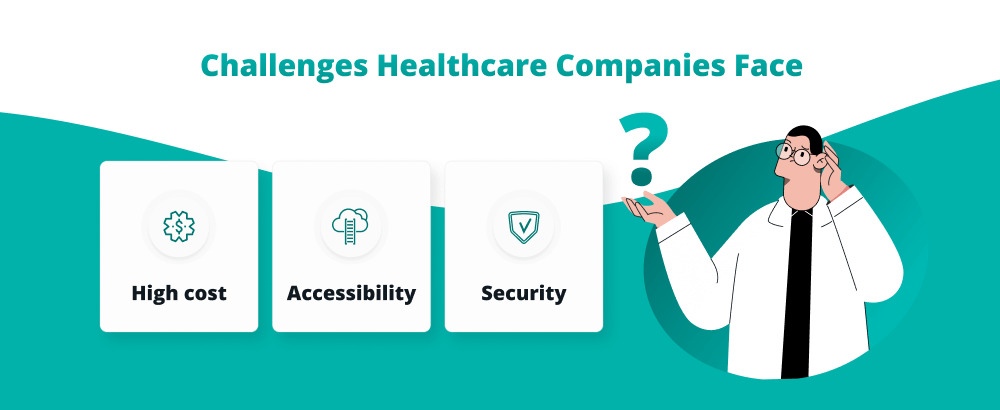
While cloud computing has a lot to offer to the healthcare industry, there are still some roadblocks to consider.
Limited functionality
Cloud computing is awesome, but it alone wouldn’t be enough to make a huge difference. It must be used in conjunction with different smart connected devices, AI, and other modern technologies. Hence, the adoption of cloud computing also requires healthcare organizations to upgrade their equipment and implement other allied technologies.
Limited talent pool
Cloud computing is relatively new, which means finding skilled professionals can be a challenge. This can potentially make recruitment a nightmare for companies transforming to the cloud. A cloud transformation agenda must comprise a detailed plan to attract hire, and retain skilled talent.
Difficulties in adoption and adaptation
Besides the recruitment challenges, a transformation to cloud infrastructure would also have an influence on existing employees. The complete process of handling tasks would change when switching from a legacy system to a cloud system. Not everyone might be able to adapt to the new technologies as easily.
Endnote
Cloud computing is certainly the future of the healthcare industry, but it still has a long way to go. Companies seeking to adopt it must upskill and train their workforce accordingly. As the talent pool in this field grows over the years, we’ll likely see more widespread adoption of cloud solutions.