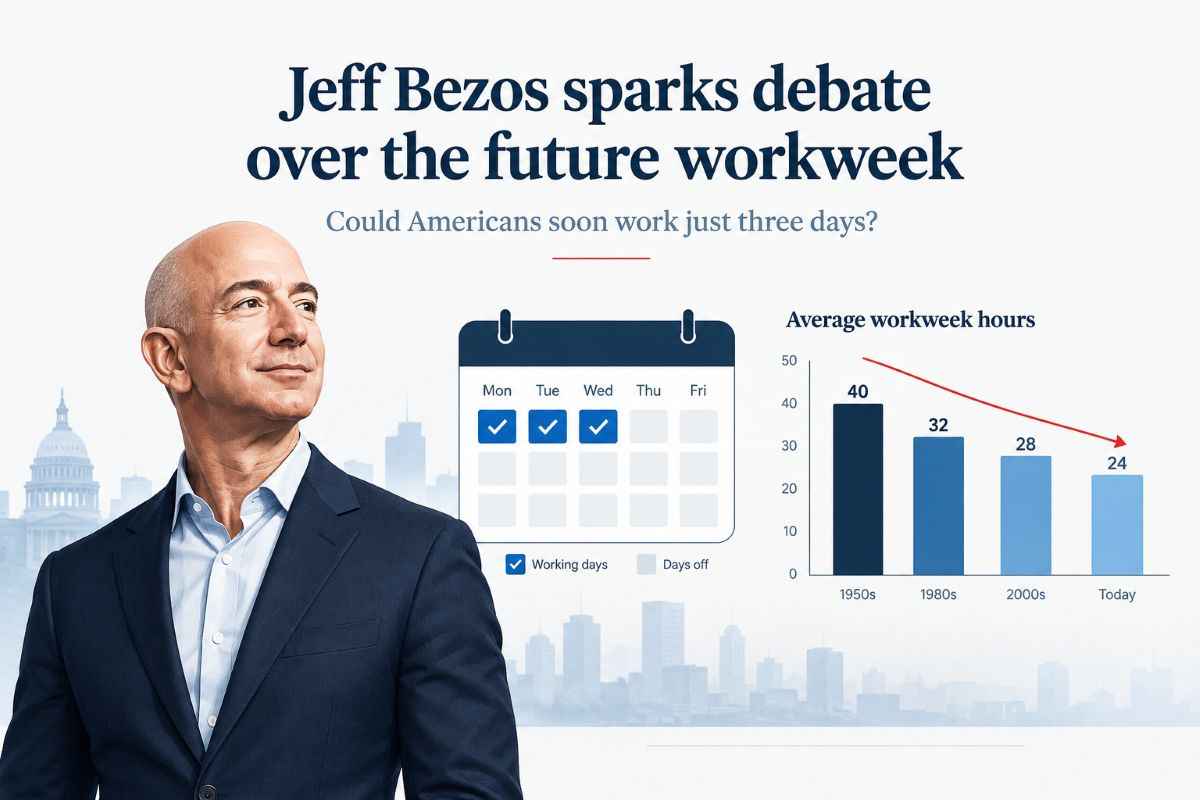
What if the traditional five-day workweek eventually became a thing of the past? Amazon founder Jeff Bezos has suggested that advances in artificial intelligence (AI) could make a three-day workweek possible for some people, raising a question that matters to millions of Americans: could workers eventually earn a living while spending less time on the job?
For US employees balancing rising living costs, demanding schedules and concerns about AI replacing jobs, the idea is appealing. But there is a significant difference between imagining a future with shorter working hours and knowing when — or whether — American employers will make it a reality.
What Did Jeff Bezos Actually Say About a Three-Day Workweek?
Bezos has discussed how AI-driven productivity could reshape employment, household finances and the amount of time people spend working. His broader argument is that AI could help businesses accomplish more with fewer resources, potentially creating opportunities for people to work less while maintaining their standard of living.
The underlying idea is straightforward: if AI can handle routine tasks, speed up research and improve business operations, workers may be able to achieve more in less time. In theory, companies could use those productivity gains to reduce working hours without cutting salaries.
However, a three-day workweek remains a possible future scenario, not an established plan for American workers. Before publication, the precise wording and context of Bezos’s latest comments should be verified against the original interview or a reliable report. His predictions should not be presented as a confirmed timeline for workplace change.
Could AI Change the Way Americans Work?
For American employees, the biggest question is how businesses will distribute the benefits of AI.
Some companies could use automation to reduce repetitive work, shorten schedules and improve work-life balance. Others may expect employees to complete more tasks in the same amount of time. Some businesses could also restructure their workforces as technology changes the skills they need.
The outcome will depend on industry conditions, management decisions, competition and how employers choose to share productivity gains.
Office-based workers in areas such as marketing, accounting, software development and customer support may see certain tasks automated more quickly. However, jobs that require physical presence, personal care or hands-on work — including nursing, construction, hospitality and emergency services — face different practical limitations.
For American families, shorter working hours could mean more time for childcare, education, caring responsibilities and personal activities. But those benefits will depend on whether employers can offer reduced hours without reducing pay or creating unrealistic workloads.
Could a Four-Day or Three-Day Week Become the New American Standard?
The idea of working fewer days is already being tested in some workplaces, but adoption remains uneven.
A major four-day-week trial involving 61 organisations across several countries, including the United States, found that many participating employers continued the arrangement after the trial. Researchers also reported improvements in employee wellbeing and work-life balance.
However, these findings do not mean every American business can adopt the same model successfully. Participating employers had chosen to take part, and the results cannot automatically be applied to every occupation or company.
There is also an important distinction between a compressed workweek and a genuinely shorter one. An employee who works four 10-hour days may have an extra day off but still work the same total number of hours. A reduced-hours arrangement cuts the actual time spent working.
For a three-day week to become widespread, employers would need to demonstrate that reduced hours can work financially and operationally across different industries.
Three Common Misconceptions About AI and Working Hours
Myth 1: AI will automatically give everyone Fridays off.
AI can improve efficiency, but shorter schedules require deliberate decisions about staffing, workloads and business operations. Technology alone cannot guarantee more free time.
Myth 2: A three-day week means the same salary for fewer hours.
That is one possible outcome, but it is not guaranteed. Some employers might preserve salaries while reducing hours; others could offer compressed schedules, part-time roles or different compensation arrangements.
Myth 3: AI will either eliminate all jobs or create unlimited opportunities.
Neither outcome is certain. AI may automate some tasks, change existing occupations and create new roles. The effects will vary across industries, workers and regions.
What Should American Workers Do Now?
Rather than waiting for a shorter workweek to become standard, employees can take practical steps to prepare for AI-driven changes.
- Build useful AI skills. Learn how relevant tools can help with routine administrative tasks, research, writing or data analysis. Always check the accuracy of their output.
- Track productivity improvements. If new tools help you complete work more efficiently, document the results and consider discussing workload, flexibility or scheduling options with your manager.
- Understand your employment agreement. Before accepting reduced hours, check how changes could affect your salary, health insurance, retirement contributions, paid leave and other benefits.
- Explore flexible-work arrangements. Depending on your employer and role, options may include remote work, flexible start times, compressed schedules or reduced hours. Ask about the company’s policies and eligibility requirements.
- Follow developments in your industry. Changes in hiring, job responsibilities and workplace technology may provide a clearer picture of how AI is affecting your occupation than broad predictions alone.
US workers should also remember that employment protections and benefits vary by state, employer and contract. Before making a major decision, check applicable state labor department guidance and the US Department of Labor’s official resources.
The Bottom Line
Jeff Bezos’s vision points to a major question about the future of work: if AI allows businesses to accomplish more in less time, will American workers receive more freedom, or will employers simply expect greater output?
A three-day workweek could become realistic for some businesses, but there is no guarantee it will become the American standard. For now, developing relevant skills, understanding workplace benefits and discussing realistic flexibility with employers are more useful than assuming a dramatic change is imminent.